Showing posts with label Artist. Show all posts

Sunday, March 19, 2017

Artist Visit - Barbara Miner

Barbara Miner
Photographer & Journalist

By: Kylee Diedrich

On February 20, Barbara Miner visited our class and discussed her work as a Photojournalist.  She went over her years as a photographer with the Milwaukee Journal Sentinel as well as the projects that she has completed most recently.  What I found amazing listening to her, was her approach to the medium.  She seems to always have a journalistic eye when she is photographing her subjects.  From her  53206MKE project to her Cuba project, she always found ways to use the camera to capture the subject, not just to capture it, but to start a discussion.  Each image she takes comes with a story, sometimes a story only she knows.

The project I felt most inspired by was the book she produced with her partner when they were at the Standing Rock Camp. The images spoke about an injustice many media news outlets were not and have not discussed. The images offer a view into the battles indigenous people's are having to fight, all because of greedy oil companies and politicians who have zero regard for indigenous rights. Miner's website does not show any of her Standing Rock photographs, but they live on in my memory. The signs posted around the camp, the many depictions of native culture and the sense of community within the photographs were inspiring. Miner brings people who could not stand with Standing Rock at the camp a way to be visually engaged and aware of the injustice.

I find Miner's work to be interactive. In her project Anatomy of an Avenue, she truly takes the viewer from the East Side of Milwaukee on a trip into the western suburbs beyond the city.  Block after block, she photographs what she sees, the people she interacts with and changes people often chose to ignore.  Her project shows a variety of social divisions over the entire stretch of the avenue across a city.
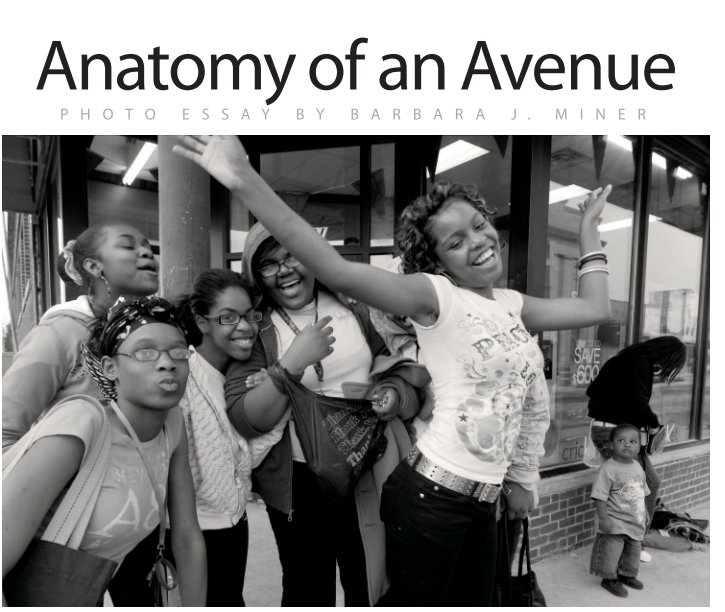
I encourage everyone to view Barbara Miner's work about Milwaukee, her photographs truly celebrate as they document the communities within Milwaukee. I am thankful for Miner's visit to class, and enjoyed hearing her talk about her process, photographic career and her inspirations as she moves forward in making new work. 


Landscape - Penelope Umbrico

Landscape: Penelope Umbrico
By Deshawn Brown

Penelope Umbrico is an artist / photographer known for appropriating images found using search engines and picture sharing websites. Her work has been published in books, exhibited and she has received awards. She was born in Philadelphia in 1957 and graduated from the Ontario College of Art and Design. She received her MFA from the School of Visual Art and PS1 Contemporary Art Center, New York. Currently, she is a faculty member in the School of Visual Arts MFA Photography, video, and related Media Program and resides in New York City. Her work is in collections including International Center of Photography (NY), McNay Museum of Art (TX), Metropolitan Museum of Art (NY), Museum of Contemporary Photography (IL), Museum of Contemporary Art, San Diego (CA), Museum of Modern Art (NY).


I feel her work,  is very simple. She doesn’t do anything on her own but search images on google, yahoo, etc. She then combines these images together into one whole rectangular collage. I understand that she wants to show the audience about how we  use the internet to consume and create materials over a period of time,but I wish there was a better outlook about the way they were captured.

Ideas - Phantasm - Mark Klett and Byron Wolfe


Ideas/Phantasm: Mark Klett and Byron Wolfe
By Deshawn Brown


Byron Wolfe is an associate Professor and the Program Director of Photography at the Tyler School of Art, Center for the Arts, at Temple University in Philadelphia. In his career as artist / photographer, he has published 4 books. One book has been solo, the other three books have been done collaboratively. Wolfe’s photographs connect his interests in time, change, and place. Currently, he is the Program Director for Photography at the Tyler School of Art.

Mark Klett is also an American photographer. He photographs the intersection of cultures, landscapes and time. Before coming into the world of photography, he had a background as a geologist and uses what he has learned to create the re-photographed images. Klett has received fellowships from the Guggenheim Foundation, the National Endowment for the Arts, the Buhl Foundation, and the Japan/US Friendship Commission. His work has been exhibited and published both nationally and internationally for over 30 years, and his work is held in over 80 museum collections worldwide.


I think that their collage ideas are somewhat like Penelope Umbrico, bothworking with re-photographed images. I do like to see the changes in the landscapes because, as humans, I do believe we are damaging the world around us and the changes from where we are and where were a century ago look totally different.
Artist Talk: Kevin Miyazaki
By Deshawn Brown


Kevin Miyazaki is a local artist/ photographer living in Milwaukee, Wisconsin. He addresses  issues around Wisconsin; about family, history and both personal and institutional spaces. His photos have been shown at The Madison Museum of Contemporary Art and The Rayko Photo Center and in solo exhibitions. Kevin is an adjunct faculty member at the Milwaukee Institute of Art & Design and was an artist in residence at the Center for Photography at Woodstock in 2015. I really enjoyed the portraits of the people that Kevin came across. He captured these people as who they are. By removing the background, the artist focused dead on all the attributes that describes each person: their hair, body size, clothing, posture, etc. The photos of the Great Lakes where he found his subjects were far less interesting to me.


Death & Destruction - Sarah Charlesworth

Sarah Charlesworth was born in 1947 in East Orange, New Jersey. She went to Barnard College where she received her BA and lived and worked in New York City. She died in 2013 of a brain aneurysm.

Charlesworth is a conceptual artist who looked at the photograph and "it's ability to deconstruct our shared symbols and public images in ways that articulate and question the values and beliefs of our culture." (artspace.com). Her website is clean and crisp. The home page was minimal, alongside an image from her Natural Magic series, only contacts for her estate and gallery business inquiries were available. The menu tabs were categorized with a section for each relevant topic.The website did not have an artist statement, so I took it upon myself to do extra research to understand her work and her life.

I was thoroughly impressed with the amount of work that was displayed, all of her works clearly organised. Each was broken up by years of the body of work, but also had the option of looking at everything at once. Some of her works had a shot text "about" the piece. I feel conceptual art is at times hard to grasp, so having a starting point is helpful in looking at and dissecting the work. My only issue was that not all of her bodies of work had an "about" text and half of the bodies that did, didn't have functioning text. Instead I was stuck with an unloaded image icon where the text should be.

The video explaining the story behind The Jumping Man, was the most relevant to that specific image.This work relates closely to that of the iconic 9/11 image of The Jumping Man. Unlike the images from Stills, the outcome and intention of the jumper is very well known. This type of image is iconic in the fact that as stated by the artists "it was the only photo that showed the death of our people that day". The image was quite, but powerful. Though it showed no gore, it became infamous. The Jumping Man is also a very relatable image because the viewer can put themselves in the situation and see that as a potential choice and rationalization behind the decision given the circumstances. The images from Stills are less static in the motions of the jumper, but they still convey a similar image without the backstory. They show a defining moment.
Charlesworth is most known for her Modern History which consists of enlarged images of newspapers with everything but the images and headlines removed. This work is still relevant to today in regards to how we as viewers, and the media itself ,documents and remembers war/crime/and headlines, but few details.

Questions: How do you feel the media portrays war/death/destruction news in the contemporary/present day?

Tuesday, March 7, 2017

Event Review Guerrilla Girls

Guerrilla Girls- MIAD Talk
By: Ryan Cindric

The Guerrilla Girls are female activist artists who first came together in 1985. The group has consisted of over 55 people with dedication ranging from a few weeks to over a few decades. They have kept their identity a secret all these years through the use of gorilla masks, its also goes well with their name (pause for chuckle).  The Guerrilla girls, in their own words, "undermine the idea of a mainstream narrative by revealing the understory, the subtext, the overlooked, and the downright unfair. We believe in an intersectional feminism that fights discrimination and supports human rights for all people and all genders."

Going into the talk I only had a very limited idea of what the girls were all about, however my mind was blown by all of the different issues they shed light on. Throughout the duration of their talk the covered the basic background knowledge of themselves, but once we got into it ideas and issues started flying around like poop in the monkey enclosure. I had no idea that the art world was as corrupt as it was; museum board members having the museum buy their personal collections for millions of dollars. As well as this, i also never knew just how unrepresented female artists, and artists of color were in museums, sometimes not even having any representation at all. Lastly, the issue of women artists trying to make a living; it seems that to make a living, in the way that we picture some of the greats, you must be male; less than 3 % of artists in the Modern Art sections are women, but 83% of nudes are women.

This was an incredibly eye opening talk into a world that i clearly don't know much about. I am incredibly thankful I had the opportunity to go and am also incredibly thankful that the Guerrilla Girls exist to expose the corruption and misrepresentation in the art world.
Landscape: Pedro David
By; Ryan Cindric

Pedro David is a Brazilian visual artist and photographer with a bachelors in journalism. He has been dedication himself to the interpretation of the relationship between people and their environment. In it's various forms and context. 


His series- Stone Men, is an interpretation of the daily life in the Brazilian northeastern outback; the inhabitants of that region, and their close relationship with the harsh nature. It's a highly hybrid culture, a mix with traditional values, pre-industrial primitive activities, and the globalized behavior. Stone Men are all of the people who inhabit this landscape, trying to understand their juxtaposition of the different times running in their moving environment. You can see how barren the landscape is, making the struggle for life one that we may never know.


His series- Things Falling From the Sky, is a series done in response to objects appearing near his apartment, he says,
 "I moved my home to a ground level apartment with two private cement areas, soon i noted, small things appearing everyday on the ground, some recur, i collect them."

It's interesting to think about all the small things on the ground that get overlooked, and how we can create an environment for them just by getting close and taking a photo with the right focus. It's also interesting how he manipulated these objects in their space, and the choices he made when setting them up. 

Sunday, February 19, 2017

Commerce/Economics - Cristina de Middel

Cristina de Middel
By: Ryan Cindric


Born in Spain in 1975, Cristina de Middel made her way to the US where she received her MA in photography from the University of Oklahoma. Returning to Europe, she earned a Fine Arts degree in Photojournalism. She describes how she blended these two disciplines,
 "The magic of the darkroom really seduced me at the beginning. Later when I finished my studies in fine arts, I didn't feel I had much in common with contemporary art practice. I felt the message was too encoded and too far away from the audience, so I decided to make a more practical use of what I had learned."
From: Afronauts
By developing interesting visual stories within documentary form, Middel created her own photographic language.  Afronauts, describes Zambian science teacher, Edward Makuka, who decided to train the first African crew to travel to the moon in 1964. Middel gives viewers actual document facsimiles accompanied by fantastical narrative photographs and  
 through her unique interpretation of the story reinterprets an historical event. She explains,
 "I wanted to try and tell interesting stories with an interesting language within photography, but still within a documentary practice." 
From: Afronauts

I am truly envious of Middel's ability to create a project knowing exactly what she wants to achieve and executing it clearly. Middel's success is based high level of visual skill, book design and editing, no matter what project is she is working on. Middle stuns viewers with unexpected concepts and execution.

From: This is What Hatred Did


Tuesday, January 31, 2017

Identity - Memory - Eva Stenram

by Morgan

Eva Stenram, originally from Sweden, is a London based artist who creates work by digitally cutting up existing images, primarily from vintage pornography and erotica. Her work has been featured in magazines such as Aperture, W, and Esquire.

When first looking at Stenram's work, I was very curious as to why she would fall into the category of memory, as I wasn't hit with that feeling when just simply viewing her work. She has a body of work in progress since 2004 called pornography/forest_pics, but by simply viewing these images I was even more lost. 

pornography/forest_pic_1

Her website is very simple, clean, and has minimal information visible when viewing images, but after clicking through a handful of these images, I realized there was a "more information" link. That's when the artist statement swooped in and saved the day. 
http://www.evastenram.co.uk/pages/mum-11.htm
"pornography/forest-pics is a series based on hardcore pornographic images that are set within or around forests. The pictures were found on the Internet and downloaded, after which the human bodies were digitally removed. The bodies are digitally removed from each shot by copying and repeating the surrounding landscape, creating visual scars within the image. Our gaze is redirected to the overlooked part of the image. The viewer is left to to complete the scene imaginatively. The photographs, once denuded of their ‘action’, also bring to mind police forensic photography, as though these were the sites of forbidding, if unnamed, events. The forest setting complements this ambiguity: at once a place of beauty and danger, of obscuring and clearing, a public as well as a private space. Its quasi-repetition throughout the series both reproduces the banality of porn itself and elaborates a typography of spaces. The human bodies in many cases gets replaced by the ground, become earth, dust and debris."
Knowing now what this work really is, I'm so much more intrigued. It's a take on the idea of memory I wouldn't have thought of myself. She removes the central focus of these images, and even though we don't ever see the original images, we're left to wonder what was once there. Although I don't find most of these images hold my interest on their own, having the information about the work makes me love the work. I'm always blown away by the ideas other artists create.